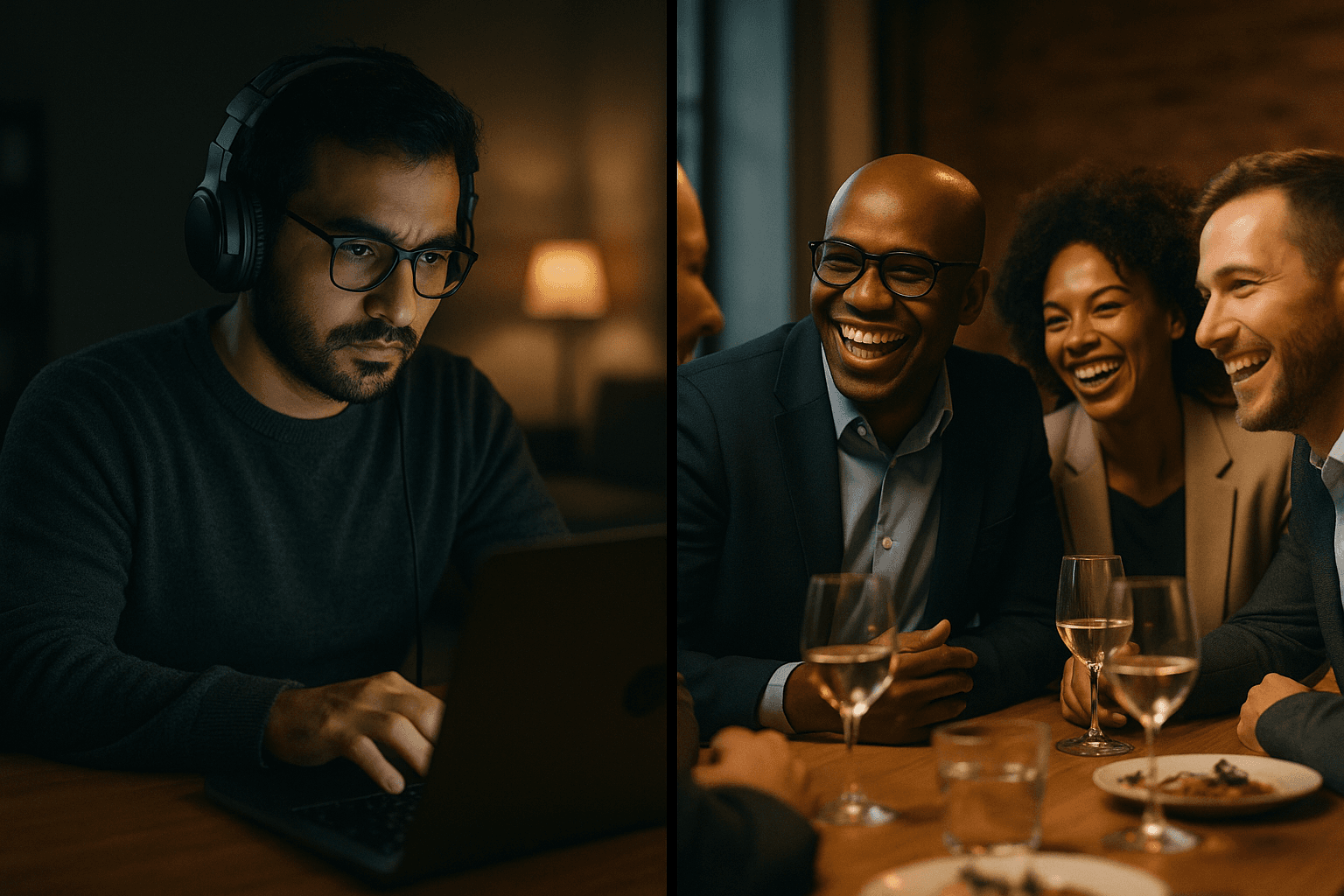
You can work with someone for two years and still not know how they handle pressure.
That's the quiet crisis of remote-first companies. Everything looks fine. Standups happen, PRs get reviewed, Slack is full of green checkmarks. But when something hard comes up — a missed deadline, a product disagreement, a moment where someone needs to be told they're wrong — the cracks appear.
Not because people are bad at their jobs. Because they've never actually met.
I've seen this happen in teams that looked, from the outside, like well-oiled machines. Strong async culture, good documentation, solid delivery. And then a reorg happens, or a project goes sideways, and suddenly no one knows how to navigate the tension. Because navigating tension requires trust. And trust requires something that no video call has ever produced at scale.
It requires shared experience.
The Illusion of Collaboration
We convinced ourselves that remote work was just office work, minus the commute. Same collaboration, same culture, same team dynamics — just from home. That was always wrong.
Remote work is fundamentally different from in-person work, not just logistically but relationally. In an office, you build context about people constantly, mostly without noticing. You see how someone reacts when a demo crashes. You grab coffee after a tough meeting. You catch a moment of frustration, or excitement, or doubt. None of that happens on a 45-minute Zoom. You show up, you deliver, you leave.
That's not a relationship. That's a transaction.
And you can run a company on transactions for a while. Until you can't.
What Remote Actually Does Well
The thing remote work does brilliantly is focus. No open-plan noise, no shoulder-tap interruptions, no commute eating two hours out of your day. I've done my best thinking remotely. Most engineers I know have. There's a real productivity gain when you control your environment and your time.
But focus is not enough. Focus gets work done. It doesn't build the culture that makes people stay, or fight for a product, or tell their manager the truth when something isn't working.
That part — the culture part — needs proximity. It needs the friction and warmth of being in the same room with someone, sharing a meal, having a conversation that goes nowhere useful but somehow matters enormously.
You cannot shortcut this. I've watched companies try. Async-first cultures with elaborate virtual offsites, Donut coffee chats, emoji-heavy Slack channels designed to simulate personality. It doesn't work. Or rather, it works the way a protein shake works — it covers the nutritional requirement but misses the entire point of eating together.
The Full-Office Trap
The answer isn't to go back to the office five days a week. That would be trading one failure for another.
Full in-person destroys the focus advantage that makes remote work worth fighting for. You're back in the meeting-heavy, interrupt-driven environment that remote was supposed to fix. The engineers who do their best work alone — and there are many — burn out or leave. You lose the talent that only comes to you because you offer flexibility.
So we're left with a tension that doesn't resolve cleanly: remote for focus, in-person for trust. You need both. The question is how to get both without pretending they're the same thing.
Intentional Hybrid
Hybrid, done intentionally, is the answer. Not "three days in the office" as a policy handed down by someone who misses seeing people at their desks. I mean a genuine design choice: remote is the default mode of work, and in-person time is reserved for the things that in-person does better than anything else.
What does in-person do better? It builds the relational foundation that makes remote work sustainable. Quarterly team gatherings where you spend real time together — not in conference rooms running through OKRs, but actually being together. Shared meals, shared walks, conversations that aren't on any agenda. The kind of time where you learn that someone is funny, or that another person gets quiet when they're stressed, or that the engineer you've disagreed with over Slack for six months actually sees the product the same way you do.
That knowledge changes everything. It changes how you interpret a terse message. It changes how much benefit of the doubt you extend. It changes whether you pick up the phone when something is hard, or just go quiet and let a problem fester.
I've seen remote teams transform after one well-run in-person week. Not because they learned anything new about the product. Because they learned something about each other.
The Signal You're Ignoring
If you work in a remote-first company and you feel like your team is productive but somehow thin, like you could be replaced tomorrow and the machine would keep running — pay attention to that feeling.
It's telling you something true. You have colleagues, not teammates. You have output, not culture. And the difference will matter the moment things get hard.
Push for the in-person time. Fight for the quarterly gathering. Don't let it get optimized away in the next budget review as a "nice to have."
It is not a nice to have. It is the foundation that makes everything else work.
Remote gives you the space to do your best work. In-person gives you the people worth doing it with. The teams that figure out how to hold both at the same time are the ones that last.
The teams that pick only one are building on sand, and they won't know it until the storm comes.