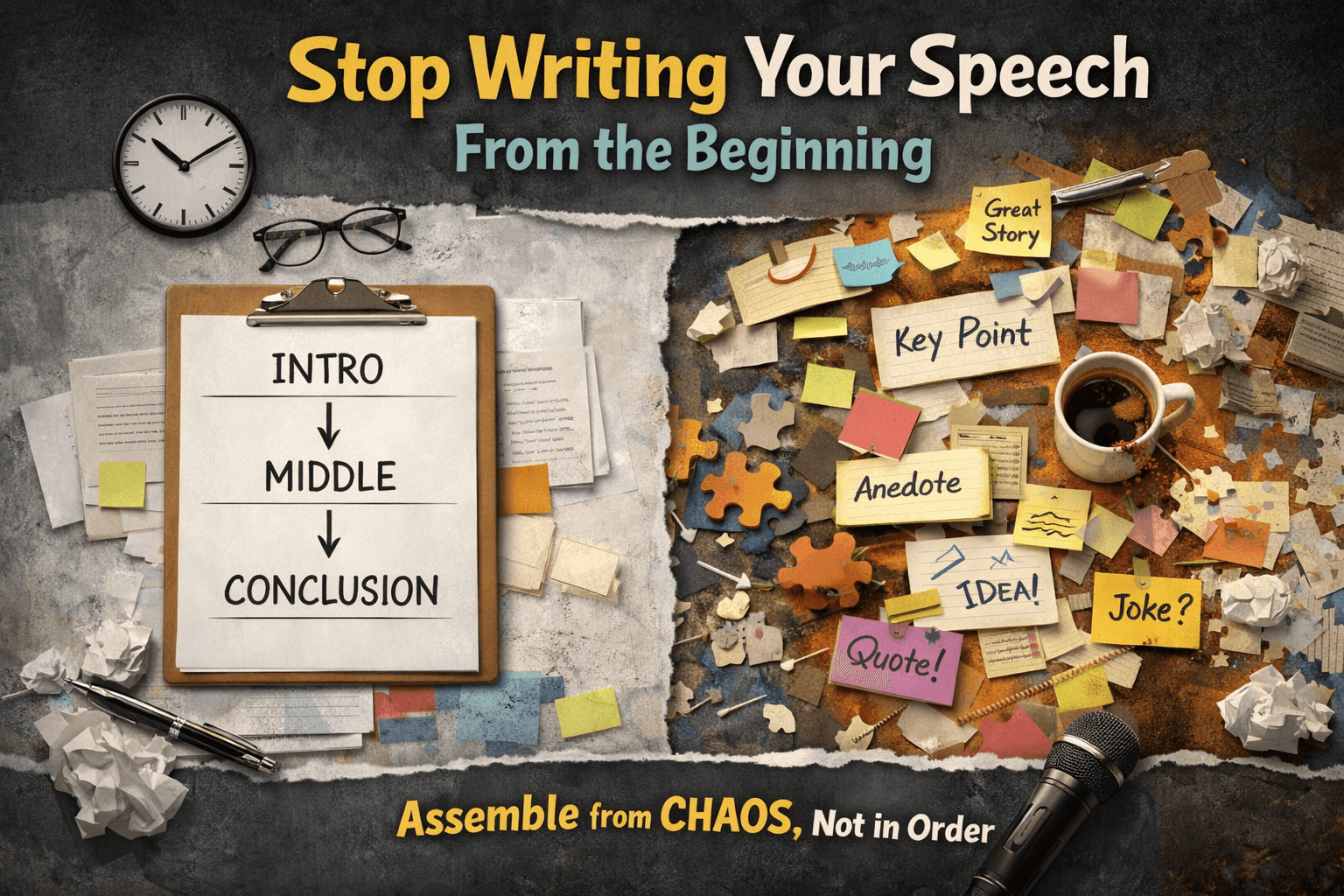
You've been staring at slide one for forty minutes. You have opinions, examples, maybe even a killer closing line floating somewhere in your head. But the opening? Nothing. So you sit there, trying to force a first sentence that earns the right to exist before you even know what you're building toward.
This is the trap. You think writing a speech means starting at the beginning and ending at the end. It doesn't. That's how you read a speech. It's not how you write one.
I've given talks at conferences, internal all-hands, pitch meetings, team kickoffs. And every single time I tried to write linearly — intro, body, conclusion, in that order — I got stuck. Not because I didn't know what to say. Because I was trying to organize thoughts I hadn't finished thinking yet.
You can't sequence ideas you haven't discovered.
The Linear Trap
There's something deeply appealing about starting at the top. It feels professional. Structured. Like you're in control. But writing a speech from beginning to end forces you to make decisions about order before you've made decisions about content. You're choosing the sequence of a story you haven't told yet.
What happens next is predictable. You write a mediocre opening because you don't know where the speech is going. Then you write a section that doesn't quite connect because you committed too early to a direction. By the midpoint, you're either rewriting the beginning or pushing through something that doesn't feel right. Both options burn time and energy on structure when you should be spending it on substance.
The worst part? You end up cutting your best ideas because they don't fit the order you locked in too early. The speech becomes a prisoner of its own outline.
Ideas First. Order Never.
Here's what actually works. You dump everything. Every idea, every example, every opinion, every half-formed thought. No slides, no order, no judgment. Just raw material.
This feels chaotic. It's supposed to. You're not writing yet — you're mining. And the quality of a speech is determined by the quality of what you mine, not by how neatly you arrange it on the first pass.
I usually end up with fifteen to twenty fragments. Some are full paragraphs. Some are single sentences. Some are just a word that triggers a story I want to tell. Most of them won't survive. That's fine. You need excess material to find the pieces that actually matter.
Then You Sequence
Once you have all your ideas laid out, something interesting happens. The structure reveals itself. You start seeing which ideas are really the same idea said differently. You notice a natural arc — a tension that builds, a turning point, a resolution. You couldn't have planned it, because it emerged from the ideas themselves.
Now you reorder. You move the strongest opening to the top — and it's almost never the first thing you wrote. You find the one idea that everything else supports, and you build around it. You cut the pieces that are good in isolation but don't serve the whole.
This is the part that feels like magic, but it's not. It's just what happens when you separate generation from organization. When you stop asking your brain to be creative and structured at the same time.
Develop and Connect
The last step is the easiest. You take each section — now in the right order — and you develop it. You write the transitions. You smooth the edges. You make sure one idea flows into the next.
This is where linear writing actually works. Once you know the order, once you know the destination, writing from point A to point B is straightforward. The hard part was never the writing. It was trying to write before you knew what you were writing about.
Why Engineers Get This Wrong
We're trained to think sequentially. Requirements, design, implementation, testing. Step one before step two. And that works for code because code has dependencies — you can't call a function before you define it.
But a speech isn't code. A speech is an argument. And arguments aren't discovered in order. They're discovered in fragments, then assembled into something that feels inevitable — even though the process that created them was anything but.
The next time you sit down to write a talk, close the slide deck. Open a blank document. And write the messiest, most disorganized brain dump you can. Trust that the structure is in there. You just have to find it after you find the ideas.
The best speeches sound like they were written in one fluid motion. They weren't. They were assembled from chaos — and that's exactly why they work.